
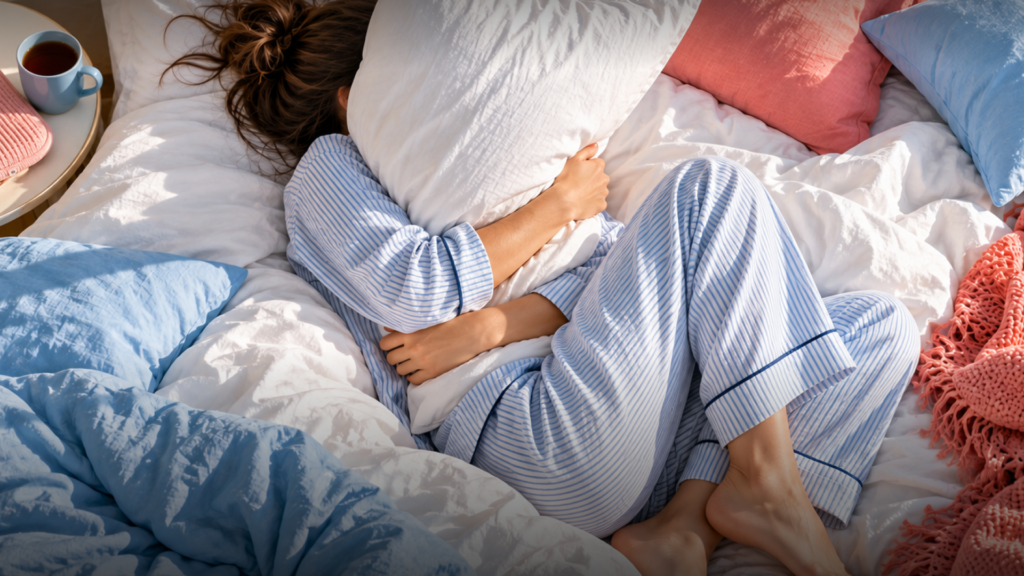
This article explains why periods can hurt, what can help, and when you should see a gynecologist.
Why does your stomach hurt during your period?
During the menstrual cycle, the inner lining of the uterus, called the endometrium, thickens to get ready for a possible pregnancy. If you don’t become pregnant, this lining sheds and leaves your body as menstrual blood.
Prostaglandins are substances that help with this process. They make the uterus contract more strongly and affect blood flow to the tissue. Their levels go up at the start of your period, which helps the uterus shed its lining.
When prostaglandin levels are high, the uterus contracts more strongly, and blood flow can decrease for a short time. This causes cramps and pain in the lower belly. Some women also feel pain in their lower back and thighs, or have nausea, diarrhea, or headaches.
Most of the time, period pain is just a normal part of the menstrual cycle and doesn’t mean you are sick. However, sometimes pain can be worse because of conditions like endometriosis, adenomyosis, or uterine fibroids.
This is why it’s important to pay attention to changes. If your periods were easy before but are now painful, if the pain is getting worse, or if it affects your daily life, see a gynecologist. The goal is not just to ease the pain, but also to find out what’s causing it and treat any underlying condition.
When is period pain a reason to see a gynecologist?
Menstrual cramps are often normal. But sometimes, the pain needs to be checked, and the cause should be found.
Book an appointment with a gynecologist if:
- your periods used to be mostly pain-free, but now the pain has appeared or become much stronger;
- the pain starts a few days before your period or continues after it ends;
- you have to miss work or school, cancel plans, or stay in bed because of the pain;
- painkillers don’t make a noticeable difference;
- you feel pain during sex, urination, or bowel movements;
- your periods have become noticeably heavier or longer.
These signs do not always mean you have a disease. However, they can happen with endometriosis, adenomyosis, and other conditions that need a diagnosis.
When do you need urgent help?
If the pain starts suddenly and becomes very severe, or if you also faint, have a high fever, or feel very weak, get medical help right away.
If you might be pregnant and have severe pain in your lower belly, do not wait to get medical help.
What helps ease period pain?
If your pain is mild or moderate and you do not have any warning signs, there are some things you can try to feel better.
1. Heat on the lower abdomen
Placing a warm heating pad or heat patch on your lower belly can help reduce cramps and make the pain less strong. Avoid using very high temperatures and do not put hot objects directly on your skin.
2. Light physical activity
Taking a gentle walk, doing some light stretching, or practicing yoga can help you manage the discomfort. You do not need to force yourself to exercise through the pain. Just choose an activity level that feels right for you.
3. Pain relief medication
Non-steroidal anti-inflammatory drugs (NSAIDs) can help with menstrual cramps. They lower the amount of prostaglandins, which can make the pain less intense.
These medicines work best if you take them as soon as you notice pain or at the start of your period. However, they are not safe for everyone. You should not take them if you have a stomach ulcer, certain kidney problems, an NSAID allergy, or some other conditions.
Choose your medicine and dose by following the package instructions, checking for any warnings, and asking your doctor for advice. If the pain keeps coming back or does not get better with treatment, talk to a gynecologist instead of just trying different painkillers.
Painful periods: when pain relief isn’t enough
Heat, gentle activity, and painkillers can help you feel better during the first days of your period. But remember, these only treat the symptoms and may not fix the underlying cause.
If you need to take painkillers, cancel plans, or change your routine every month because of period pain, it is a good idea to find out why the pain keeps returning.
Sometimes, the pain is simply due to how your menstrual cycle works. But painful periods can also be a sign of endometriosis, adenomyosis, uterine fibroids, or other conditions.
If the pain keeps coming back, gets worse, or affects your daily life, do not rely only on painkillers. It is better to see a gynecologist. This does not always mean you have a disease, but a consultation can help you find out if you need more tests and what treatment is best for you.
Gynecologist in Tbilisi
Gynecology is a main specialty at Silk Medical. Here, you can see an experienced gynecologist, get any needed tests, and find the right treatment all in one place.
If you are troubled by painful periods, the doctor can help you find out if the pain is just part of your cycle or a sign of another condition. During your visit, the specialist will ask about your pain, your periods, and any other symptoms. If needed, they may order an ultrasound, lab tests, or other checks.
At Silk Medical, we offer:
- diagnosis and treatment of pelvic organ conditions;
- treatment of inflammatory and endocrine gynecological conditions;
- contraception counseling;
- women’s health screenings;
- pregnancy care;
- diagnosis and treatment of sexually transmitted infections;
- diagnostic and therapeutic pelvic procedures.
Silk Medical stands out because of our complete approach. If you need to see another specialist or have more tests, you can do everything in our multi-specialty clinic. This is helpful if the cause of your pain is not only gynecological and needs a wider approach.